Toyota’s Collaborative Safety Research Center Touts Partnerships, Eyes Future with Announcement of 10 New Projects
PR Newswire
ANN ARBOR, Mich., June 2, 2026
- New research projects focus on behavioral safety, crash prevention and passive safety
ANN ARBOR, Mich., June 2, 2026 /PRNewswire-HISPANIC PR WIRE/ — Before joining Toyota’s Collaborative Safety Research Center (CSRC), Zhaonan Sun spent years studying how the human body absorbs the force of a crash.
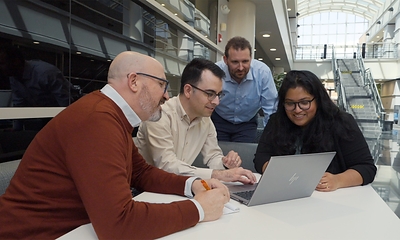
Now, as a principal scientist at CSRC, he helps identify opportunities to do something about it.
Sun was a graduate student at the University of Virginia (UVA), studying injury biomechanics and human body modeling under Jason Kerrigan, director of UVA’s Center for Applied Biomechanics since 2019 and long-time collaborator with CSRC. As fate would have it, the researcher Sun once trained under is now his colleague.
“He spent the time to understand the background. He went and really tried to make the project successful — and he made it sing,” Kerrigan said of Sun’s graduate research. “I was sad to see him go, but I’m really glad he found his way back, this time on the Toyota side.”
For Sun, moving from the lab to Toyota revealed something he hadn’t been able to see before.
“I wouldn’t say the work at the university is the tip of the iceberg. I would say it’s half of the iceberg,” he said. “And now it’s great to see the other half — how we leverage the results to talk to our regulators, rating agencies, and safety stakeholders to reduce the number of fatalities on the road.”
Sun’s path from UVA to Toyota is, in many ways, the story of CSRC itself. When Toyota launched CSRC in 2011, the company posited that investing in safety research in clinical, laboratory, and university settings could pay greater dividends than keeping the work in-house. Now, more than 100 completed studies later, their work is only accelerating.
Today, CSRC announced 10 new safety research projects, in collaboration with seven universities and private sector organizations including UVA, the Massachusetts Institute of Technology, the University of Michigan and Purdue University. These projects range from how adaptive interfaces can increase driver adoption of advanced safety systems, to new methods for detecting pedestrians and cyclists, to how speeding risk varies by road type and the gap between a driver’s speed and posted limits.
“CSRC was built on the idea that the best safety research happens when you invest in relationships over time, with the best institutions, the best researchers, and a shared commitment to publishing what you find,” said Jeff Makarewicz, TMNA Group Vice President, R&D. “Each of these 10 new projects reflects that approach, building up research capabilities and institutional knowledge.”
CSRC Senior Manager Jason Hallman sees these 10 new projects as a continuation of what he calls a “1+1 = 3 relationship.” In short, Toyota’s engineering knowledge, related government and safety research activity, and academic expertise combine into something no one could produce alone.
“The work we undertake now will build and shape the safety features drivers can benefit from for decades to come.” Hallman said. “Every project we select is a strategic investment in that future: in even safer vehicles, enhanced engineering tools, and results we hope the industry and policymakers can build on.”
At the heart of much of this work is THUMS, the Total Human Model for Safety, a Toyota-developed virtual human body model that allows researchers to simulate crashes in a digital environment with unprecedented levels of detail.
Although they have their own limitations, computational models can run far more simulations and can predict nearly 100 injury types simultaneously. Sun, who works across multiple university collaborations at CSRC, sits at the center of that process — coordinating between university researchers, Toyota engineers, and safety stakeholders to put the findings to work.
That sense of purpose extends to the researchers CSRC has helped train over 15 years, many of whom have gone on to positions in government, academia, and across the automotive industry, and in a few cases, like Sun, to Toyota itself.
“It’s very exciting to have my fingerprint on the future of vehicle safety,” he said. “Using human body models and doing virtual testing is a professional passion of mine. I’m excited to see where the future leads with these new projects and how we can help to better protect everyone on the road.”
Details on each of the 10 new projects are below.
Collaborator: Massachusetts Institute of Technology
Project Name: Adaptive Interfaces for increasing ADAS adoption
Key Question: How do a driver’s expected benefits and concerns affect when they choose to use advanced driver assistance (ADAS) across various situations?
Approach: Drivers will view various story-framed driving videos and report their perceived effort, value, risk and likelihood to use specific ADAS features.
Collaborator: Purdue University/Ohio State University
Project Name: Naturalistic vulnerable road user (VRU) detection with Micro-Doppler Radar
Key Question: How can current radar sensors signals and novel AI models enhance VRU detection for future rating assessments?
Approach: Researchers will collect real-world radar data from current automotive sensors and use it to develop novel AI algorithms that can more quickly detect and distinguish between pedestrians, cyclists, and other road users.
Collaborator: Touchstone Evaluations, Inc.
Project Name: Speeding-related crash outcomes based on road type and context
Key Question: What are the injury and fatality risks of speeding based on posted speed limit and speed differential?
Approach: Researchers will analyze crash data to measure how injury and fatality risk changes based on road type, posted speed limit, and how far a driver is traveling above it.
Collaborator: Touchstone Evaluations, Inc.
Project Name: Speed compliance effects on surrounding vehicles
Key Question: How does a driver’s speed affect the surrounding traffic behavior?
Approach: Researchers will analyze real-world driving data to quantify how a driver’s speed — compared to surrounding traffic — affects the behavior of nearby vehicles.
Collaborator: University of Michigan Transportation Research Institute (UMTRI)
Project Name: Parametric studies with varying size/shape human body models (HBM)
Key Question: How to treat different HBMs to align virtual testing results across OEMs and regions?
Approach: Researchers will run virtual crash tests using three widely available HBMs across standard and modified geometries to identify ways to align results across automakers and regions.
Collaborator: University of Michigan-Dearborn/UMTRI
Project Name: Vehicle to network (V2N) safety benefits for anticipatory assistance
Key Question: How can V2N communication be best leveraged to increase driver safety?
Approach: Researchers will leverage international efforts and U.S.-specific crash and driving records to identify where vehicle-to-network communication can best give drivers earlier warning of potential hazards ahead.
Collaborator: University of Virginia
Project Name: Virtual testing sensitivity to human body model (HBM) updates
Key Question: What are the effects of small changes in HBMs on injury metrics and virtual testing results?
Approach: Researchers will build an automated simulation framework to test how small version updates to virtual human body models affect injury predictions in crash scenarios.
Collaborator: University of Virginia
Project Name: Foot posture and implication for ankle injury risk prediction
Key Question: What are the predicted effects of a range of footwell geometries and foot posture on ankle injury risk?
Approach: Researchers will collect vehicle interior measurements and run computer simulations to understand how different foot positions and footwell designs affect ankle injury risk in a crash.
Collaborator: University of Virginia
Project Name: Lumbar spine injury prediction with crash test dummies
Key Question: How to enable lumbar spine injury risk prediction in upright and reclined seating positions from values provided by different dummies?
Approach: Researchers will run crash simulations to develop a method for translating lower-back injury readings from crash test dummies into injury risk predictions for real occupants.
Collaborator: University of Wisconsin-Madison
Project Name: Alert annoyance and interaction mitigation strategies
Key Question: Do the characteristics of the alert source influence the driver’s level of annoyance?
Approach: Volunteers will complete scenario-based surveys and interviews to measure how different types of alerts — and where they come from — affect driver annoyance and use of safety and convenience features.
About Toyota
Toyota (NYSE:TM) has been a part of the cultural fabric in North America for nearly 70 years, and is committed to advancing sustainable, next-generation mobility through our Toyota and Lexus brands, plus our more than 1,800 dealerships.
Toyota directly employs nearly 64,000 people in North America who have contributed to the design, engineering, and assembly of over 50 million cars and trucks at our 14 manufacturing plants. In 2025, Toyota’s plant in North Carolina began to assemble automotive batteries for electrified vehicles.
For more information about Toyota, visit www.ToyotaNewsroom.com.
About TMNA R&D
For more than 50 years, Toyota’s Research & Development groups in North America have participated in engineering projects for several of the best-selling Toyota vehicles on U.S. roads. Teams are now creating both next-generation vehicles and new and advanced mobility concepts that can better move people, goods and information. Centered in Ann Arbor, Michigan, Toyota’s North American R&D groups are pursuing Toyota’s mission to “Produce Happiness for All” by making life safer, easier and more enjoyable.
Media Contact
Dan Nied
[email protected]

SOURCE Toyota Motor North America